
Don’t Touch The Mailbox
A small business marketing mistake looks harmless in the field. But the moment a flyer lands on the wrong surface, the brain can reject it before the offer is ever seen.
I was driving through a neighborhood when something made me slow down and pull over.
Not construction. Not an accident.
A mailbox.
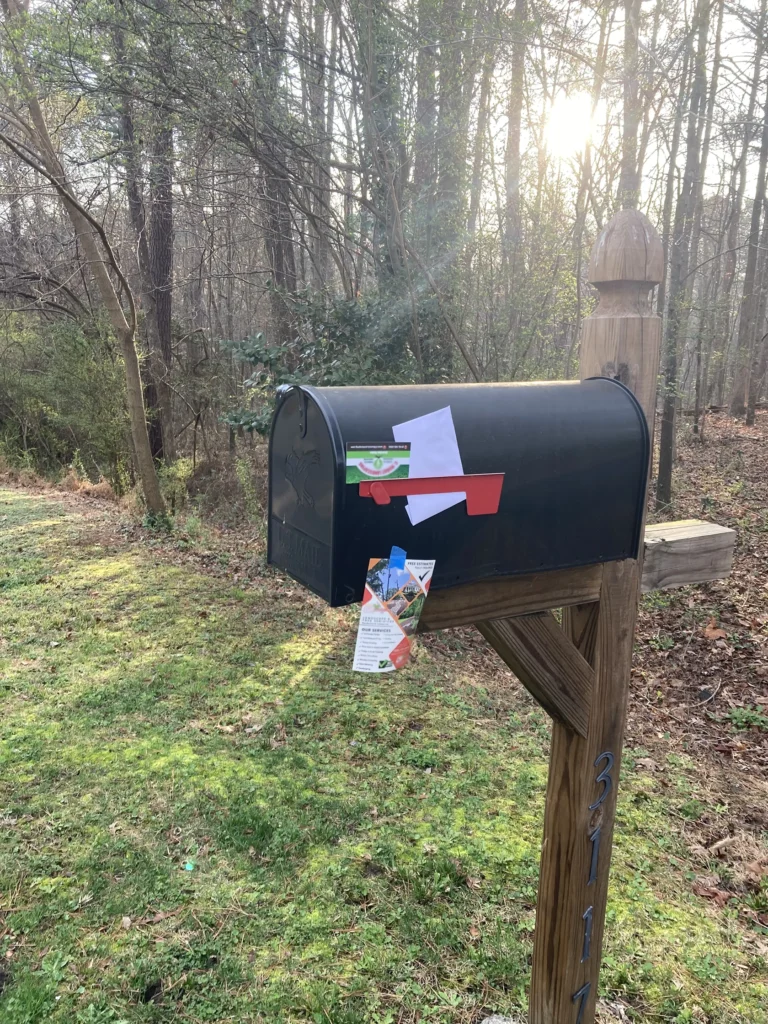
I put the car in park and took a photo, because what I was looking at told an entire story about small business marketing in a single frame.
Three different businesses had left their mark on the same post. A flyer taped to the side. A business card wedged under the flag. Another flyer hanging from the front, slowly losing its grip to the wind.
Each one of those businesses believed they were getting their name out there.
The Logic That Feels Right
The thinking behind this isn’t hard to understand.
Print flyers. Drive the neighborhood. Leave them where homeowners will see them. The job is simple. The cost is low. The crew covers the street and moves on.
It feels like marketing. It looks like effort.
But there’s a gap between the moment that flyer gets placed and the moment the homeowner finds it. And in that gap, something important gets missed.
What the Mailbox Actually Is
Most objects on a property are just objects. A garden hose. A lawn ornament. A utility box.
The mailbox is different.
It sits in a unique psychological space that most businesses never stop to think about. It’s where the outside world makes contact. Bills. Letters. Documents that matter. Even in an era where most communication has moved to a screen, people carry a quiet sense that their mailbox belongs to them in a way the driveway doesn’t.
Psychologists refer to this as territorial priming. Certain spaces trigger a sense of personal ownership that bypasses rational thinking entirely. When something unexpected appears on that space, the reaction isn’t curiosity. It isn’t evaluation.
It’s removal.
The brain doesn’t slow down to consider the offer. It makes a category judgment the moment the flyer is seen: this doesn’t belong here. Then the hand follows. Everything attached to that mailbox goes straight into the trash.
The business name never registers. The service never enters consideration. The signal never had a chance.
Now multiply that by three companies on the same post.
The homeowner isn’t comparing services. They’re mildly irritated. They grab everything, strip it off, and go inside.
Three businesses competed for the same mailbox.
None of them were seen.
There’s Also a Legal Layer
Many businesses doing this genuinely don’t know the rules around it.
Under 18 U.S.C. § 1725, placing unstamped mail inside a mailbox is illegal. The USPS holds exclusive access to the interior, not because of red tape, but because the mailbox is part of the federal mail system. The law exists specifically to prevent businesses from bypassing postage and flooding neighborhoods with unpaid advertising.
Taping flyers to the outside or wedging cards under the flag lives in a gray area. Many municipalities have their own ordinances against unsolicited advertising on private property. At best it’s ambiguous. At worst it’s a fine and a reputational problem.
Proper channel
Programs like Every Door Direct Mail, or EDDM, allow businesses to send postcards to entire ZIP codes and carrier routes at a lower per piece cost than standard postage. You choose the neighborhood. The piece arrives through the mail. The homeowner holds it with the rest of their correspondence.
That’s the difference between forcing your way in and earning a moment of attention.
The Real Problem Is Who’s Executing
Most of the time, this isn’t a deliberate strategy.
It’s an instructions problem.
A business owner tells the crew to hand out flyers. The crew’s job becomes simple: finish the route. The mailbox is the fastest place to leave something and move on. Nobody in that truck is thinking about territorial psychology or federal statutes.
They’re thinking about how many streets are left.
So the flyer goes up. Another company’s crew does the same thing an hour later. A third follows after them.
By the time the homeowner gets home, there’s a stack of competing advertisements on their post, three businesses, none of them visible, each one accidentally connecting their brand to the mild frustration of cleaning off a mailbox.
The business owner never intended that. But intention doesn’t change the outcome.
The Moment Before the Door Closes
Most advertising fails long before a customer ever evaluates the offer.
A signal appears. The brain makes a quick decision. The door closes.
That’s what happens at the mailbox. The homeowner sees clutter attached to something that feels personal, and the door shuts before the first word is read. It isn’t personal. It isn’t a judgment about the business. It’s just how the brain works when something lands in the wrong environment.
Intentional marketing doesn’t guarantee a sale. But it does one thing well. It keeps that door open long enough for something to happen.
A brief glance. A moment of reading. A name that gets remembered later when the need shows up.
That pause is small. But it’s where every opportunity in marketing begins.
What the Contrast Looks Like
Imagine the same homeowner. Same driveway. Same afternoon.
They walk out and the mailbox is clean. When they open it, there’s a single postcard sitting between two envelopes. It arrived through the mail. It has a stamp. It came through the proper channel.
The card is well designed. A clear headline. One strong visual. A simple message about a service that makes sense in that neighborhood.
The homeowner is already holding their mail. Already in the habit of sorting through it.
They glance at the card.
Maybe they read it.
Maybe it goes on the counter instead of the trash.
The postcard didn’t ambush them. It arrived where correspondence arrives. And that small act of respect, showing up through the right channel, in the right environment, changes how the brain receives the signal entirely.
It still doesn’t guarantee a call.
But it earned something the taped flyer never did.
Visibility Comes From Intention
Many small businesses confuse activity with intention.
More flyers. More neighborhoods. More impressions. The instinct makes sense when you’re trying to grow. But more contact isn’t the same as more visibility.
Visibility happens when a signal lands in the right environment and the brain doesn’t immediately discard it.
- A clean door hanger on a front door communicates differently than a flyer taped to a mailbox.
- A yard sign placed after a finished job nearby communicates differently than a card wedged under a flag.
- A clearly branded truck parked on the street communicates differently than an anonymous flyer no one will read.
Where you place your name tells people something about who you are before they read a single word.
Some signals are worth paying for. Some environments are worth respecting.
Closing Thought
And sometimes the most effective marketing decision is knowing which space to leave alone.
Don’t touch the mailbox.